Warning
This section is under development.
Management Units#
An important component of the PEM framework is the creation of Management Units, denoted here as UPG — spatial zones that organize and guide the ocean space management. UPGs are used to support decision-making and scenario analysis, ensuring that management strategies reflect ecological patterns, human activities, and the connectivity between land and sea.
These units are derived from input data such as bathymetry, habitats, and coastal uses, combined with expert-defined thresholds for distance, depth, and sensitivity.
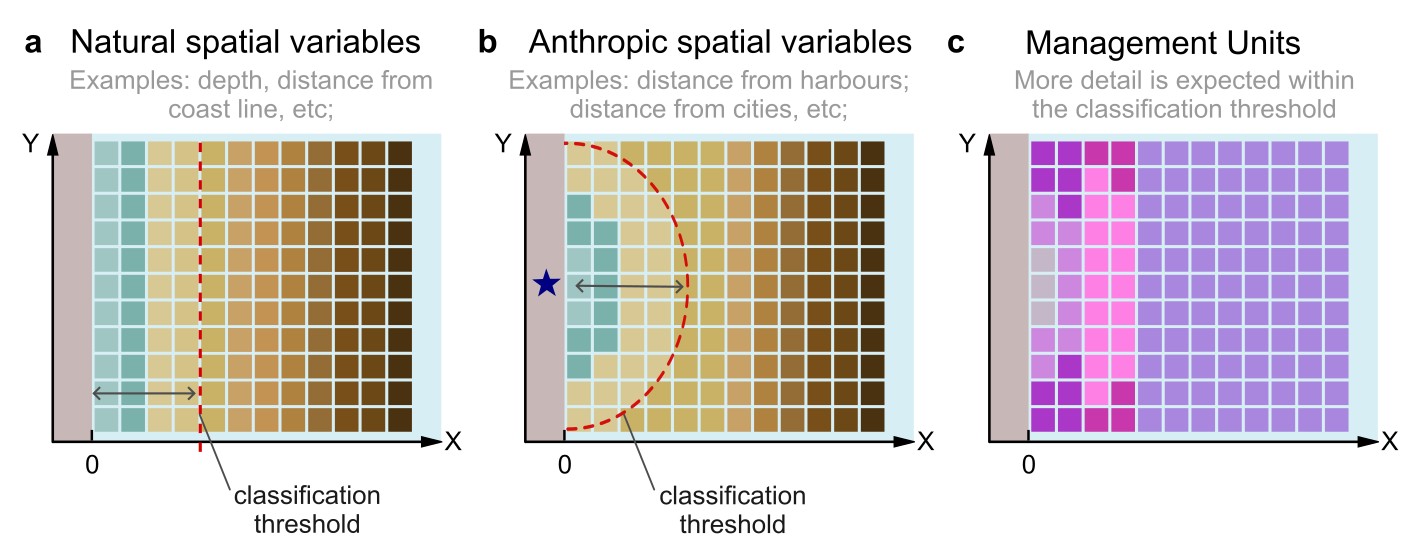
Definition of management units in the PEM framework. (a) Natural spatial variables (e.g., depth, distance from the coastline). (b) Anthropogenic spatial variables (e.g., distance from harbors and coastal cities). (c) Resulting spatial units derived by overlaying variables and applying classification thresholds—defined through expert input or stakeholder consultation—producing distinct management units with unique attribute profiles to guide planning and management.#
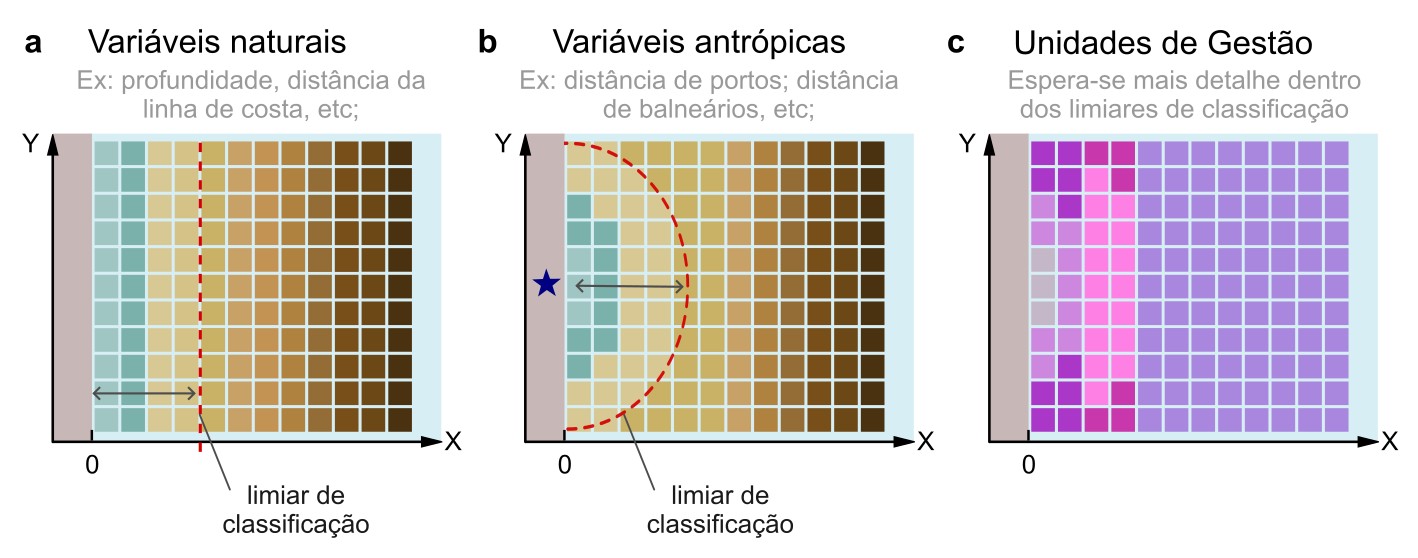
Definição de unidades de gestão e planejamento no framework PEM. (a) Variáveis espaciais naturais (por exemplo, profundidade, distância da linha de costa). (b) Variáveis espaciais antrópicas (por exemplo, distância de portos e de cidades costeiras). (c) Unidades espaciais resultantes da sobreposição das variáveis e da aplicação de limiares de classificação — definidos por especialistas ou em consulta a partes interessadas — gerando unidades de manejo distintas, cada uma com um conjunto único de atributos para orientar o planejamento e a gestão.#
Management Levels#
Management units can be organized hierarchically to support planning at multiple spatial scales. At the macro level, broad variables such as depth, distance from the coast, or distance from ports and coastal cities are used to segment the marine space into large management units that reflect major environmental and socioeconomic patterns.
Once these macro units are defined, the framework can move to meso or micro levels by adding finer-grained variables. Habitat maps or local use patterns can create nested units with greater detail. This hierarchical structure maintains consistency across scales while allowing management guidance to reflect both broad patterns and local nuances.